
Call a 24/7 emergency restoration service now. Removing standing water and starting structural drying within the first 24 to 48 hours is what stops mold from taking hold and prevents a soaked carpet from turning into rotted subfloor. If the water might be contaminated, stay out and let trained technicians handle extraction with the right protective gear.
TL;DR:
- Promptly shutting off water and power within 60 to 120 minutes prevents mold growth and structural damage, especially in contaminated water scenarios.
- Professional extraction uses high-volume equipment, moisture monitoring, and thermal imaging to ensure all hidden water is removed before drying.
- Handling Category 3 black water requires PPE, containment, and disposal protocols, with contaminated materials like carpet and mattresses usually needing replacement.
- Accurate documentation and moisture measurements during drying are crucial for insurance claims and prevent mold reappearance.
- A certified emergency response crew handles the entire process, from source control to reconstruction, reducing long-term damage and health risks.
Table of Contents
- What To Do In The First 60 To 120 Minutes
- How Professionals Extract And Dry A Flooded Property
- Clean, Gray, Or Black Water: Why It Changes Everything
- What A Professional Response Actually Looks Like
- What Drives The Timeline And The Price
- Why A Certified Crew Matters When You’re Under Pressure
- The Part Of This Process Homeowners Consistently Underestimate
- How To Reach Speedycons When Water Is Already Spreading
- Sources
What To Do In The First 60 To 120 Minutes
Before any crew shows up, your job is triage, not repair. Get people and pets out of standing water, and if reaching the breaker panel means walking through water, leave the power alone and call an electrician instead of risking a shock.
Here’s the order that actually protects your property:
- Shut off the water source if you can reach it safely, whether that’s a burst supply line’s isolation valve or the main shutoff.
- Cut power to the affected area at the breaker, but only if the panel is dry and accessible.
- Photograph everything, room by room, before you move or touch anything.
- Move electronics, furniture legs, and valuables off wet flooring and into a dry room.
- Skip the shop vac. A household vacuum on deep water is a shock hazard and won’t move enough volume to matter anyway.
Don’t run your HVAC system either. It circulates moist air through ductwork and can spread contamination to rooms that were never touched by the flood.
Pro Tip: Take a wide shot of each room plus close-ups of baseboards, outlets, and any visible waterline before you start moving anything. Adjusters and restoration crews both rely on that “before” picture.
How Professionals Extract And Dry A Flooded Property
A restoration crew doesn’t just show up and start vacuuming. The first move is a safety walk-through: checking for electrical hazards, confirming the source is controlled, and identifying which rooms have the deepest standing water so extraction can start there first.
From that point, the process runs on specialized equipment most homeowners don’t have access to:
- Truck-mounted extractors handle high-volume standing water fast, often pulling hundreds of gallons in a single pass.
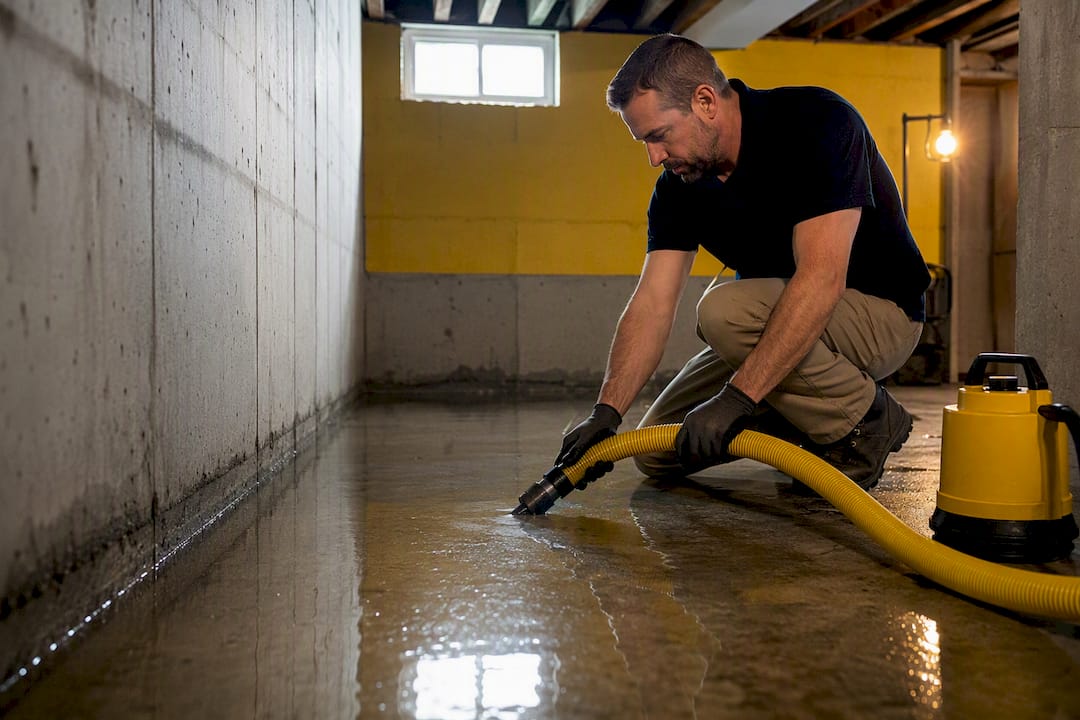
- Submersible pumps clear basements and low points where water has pooled below floor level.
- Portable extractors work smaller rooms and tight spaces the truck-mounted units can’t reach.
- Weighted extraction tools press down on carpet and padding to pull out moisture that’s soaked deep into the fibers, water an ordinary vacuum leaves behind entirely.
Getting the visible water out is only half the job. Air movers push moisture off wet surfaces so it evaporates faster, and low-grain-refrigerant (LGR) dehumidifiers pull that moisture out of the air before it settles into drywall and framing again. Technicians use moisture meters and thermal imaging to find water hiding inside walls or under flooring, since extraction without follow-up structural drying and monitoring leaves materials unstable even after the floor looks dry. That’s the piece a lot of DIY cleanups miss: the carpet looks fine on day two, but the pad underneath is still holding water that will feed mold by day five.
Clean, Gray, Or Black Water: Why It Changes Everything
Not all water damage carries the same risk, and the category determines whether you can help with cleanup or need to stay away entirely.
- Category 1 (clean water): Comes from a burst supply line or overflowing tub. Low health risk if you act fast, but it can degrade into Category 2 within 48 hours if it sits.
- Category 2 (gray water): Contains contaminants like soap, food residue, or minor chemical exposure, typically from washing machines, dishwashers, or sump pump backups.
- Category 3 (black water): Sewage backups, flooding from rivers or storm surge, or any water that’s been sitting long enough to grow bacteria. This requires PPE, containment, and often specialized disposal.
Porous materials that soak up Category 2 or 3 water usually can’t be saved. The American Red Cross recommends discarding mattresses, carpeting, and stuffed toys exposed to floodwater rather than trying to disinfect them, and that same guidance applies to any food, drinks, or medicine that came into contact with flood water. When in doubt, throw it out. If you smell sewage or see standing water with visible sediment, that’s the line where DIY stops and a biohazard-trained crew takes over.
What A Professional Response Actually Looks Like
A legitimate emergency water service doesn’t just quote a time window and disappear. Expect a structured process from the first call to the final report.
- Phone triage where the dispatcher asks about the water source, category, and any immediate hazards, then gives you a realistic ETA.
- An on-site walk-through where the technician verifies the source is controlled and maps which areas took the most damage.
- Baseline moisture readings and photos taken before any equipment goes in, since insurers rely on this early documentation as proof mitigation started promptly.
- Daily or scheduled moisture-meter logs during the drying phase to track progress and confirm materials are actually drying, not just sitting under a fan.
- Coordination with your plumber and insurance adjuster, since a documented, fast response often influences how quickly a claim gets approved.
That paper trail matters more than most homeowners realize until they’re mid-claim and an adjuster asks for proof of when mitigation began.
What Drives The Timeline And The Price
No two water losses cost the same, and the quote you get depends on a handful of concrete factors rather than a flat rate.
- Water category matters most. Clean water cleanup costs less than a Category 3 sewage job requiring containment and disposal protocols.
- Square footage and affected materials drive labor and equipment needs. Hardwood and drywall dry differently than carpet and behave differently when saturated.
- Hidden migration behind walls or under flooring can turn a “small leak” into a multi-room drying job once thermal imaging finds where the water actually traveled.
Extraction itself usually takes hours. Drying and monitoring run days to weeks depending on how much material absorbed water. Reconstruction, if drywall or flooring needs replacing, can add weeks on top of that.
Pro Tip: If a quote skips moisture mapping entirely, or offers no monitoring plan after the initial extraction, treat that as a red flag rather than a bargain. Drying that isn’t measured is just a guess.
One more caution on basements: don’t pump out a flooded basement all at once. Removing water too fast can let exterior hydrostatic pressure crack or collapse a foundation wall, which is why professionals often stage the pump-out gradually rather than draining it in one shot.
Why A Certified Crew Matters When You’re Under Pressure
Speedycons runs 24/7 emergency response with technicians trained to work within local building codes, which matters most when electrical systems, gas lines, or structural framing are involved in a flood. The crew handles source control, extraction, and drying equipment placement, and manages electrical and fire risk on-site rather than leaving that judgment call to a homeowner standing in a wet basement.
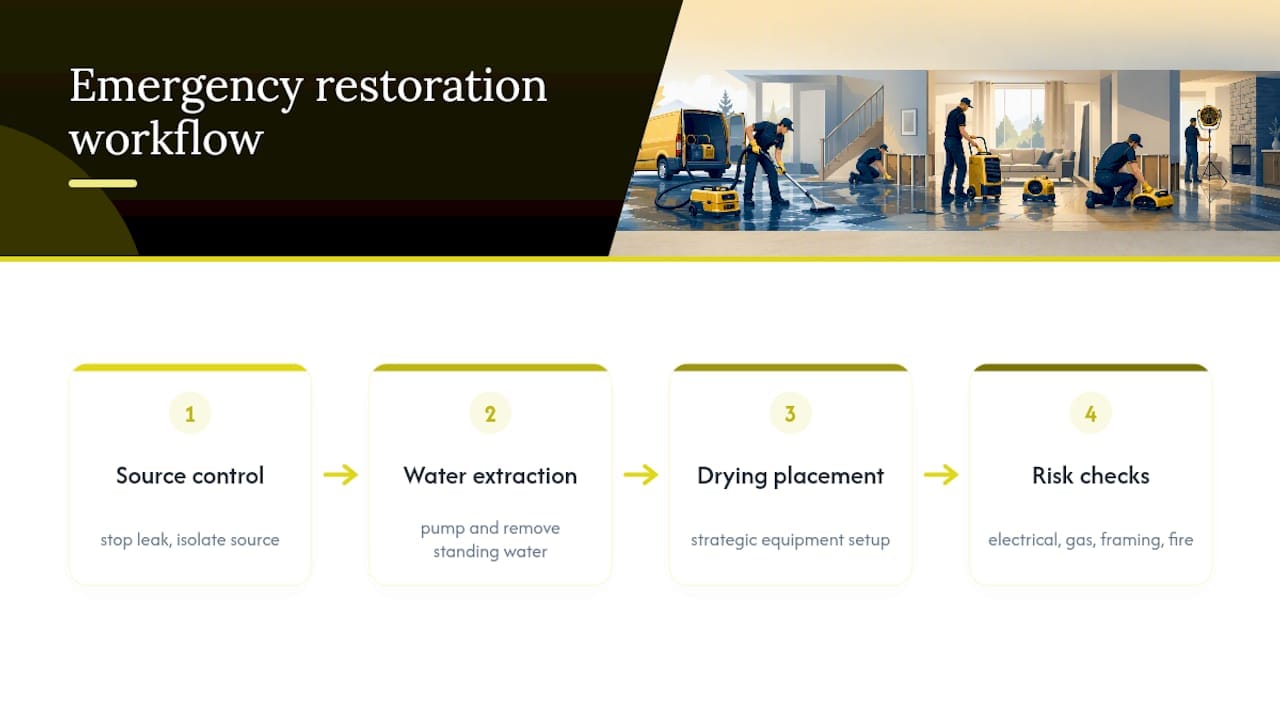
Every job includes documented moisture readings and photos from the first visit onward, giving property managers and homeowners a paper trail their insurance adjuster can actually use. Beyond drying the structure, Speedycons handles content restoration and manages the project through to reconstruction, so a single point of contact covers the entire loss instead of juggling separate contractors for extraction, drying, and repair.
The Part Of This Process Homeowners Consistently Underestimate
Most advice on water damage fixates on speed alone, and speed matters, but it’s not the whole story. What actually separates a clean recovery from a mold problem six weeks later is whether anyone measured the drying, not just whether extraction happened fast.
A crew that pulls standing water and leaves without checking moisture levels in the subfloor or wall cavities has done half a job. That’s the gap conventional advice glosses over: visible dryness on day two means nothing if a moisture meter would show 18% saturation still trapped behind the baseboard.
If you take one thing from this, prioritize documentation and monitoring over raw response time. A crew that shows up in 90 minutes but skips moisture mapping will likely cost you more in the long run than one that arrives in two hours with a plan to measure progress daily. Speed gets the water out. Measurement is what keeps it from coming back as mold.
How To Reach Speedycons When Water Is Already Spreading
When you call, have your address ready, the source of the water if you know it, whether it’s clean or potentially contaminated, and any immediate hazards like exposed wiring or a sagging ceiling.
Speedycons is the alternative to piecing together separate contractors for extraction, drying, and repair. One crew handles the entire loss from the first call. You’ll get a real ETA, not a vague window, and the technician who arrives starts triage immediately: confirming the source is controlled, beginning extraction, and placing drying equipment while documenting every moisture reading for your insurance file. That documentation becomes part of your claim from day one instead of something you’re scrambling to reconstruct later.
If water is actively spreading through your home or building right now, visit the water damage restoration page to reach Speedycons directly and get a technician dispatched.
Sources
- Addressing moisture and mould in your home, Health Canada
- Disaster cleanup guidance, American Red Cross
- IICRC, Institute of Inspection, Cleaning and Restoration Certification
Recommended
- Water Damage Restoration GTA
- How Fast Mold Grows After Water Damage | 24-48 Hours?
- What Happens If Water Damage Goes Untreated Indoors?
- Mould Remediation GTA | Professional Mould Removal Service
More Guides
Need professional help? Explore asbestos abatement services.