
You can often save a flooded carpet if you stop the water and start extraction within the first 24 to 48 hours. Wait longer than that, or if the water came from a sewer backup or floodwater, and mold plus pad damage usually force a full replacement. Your first move: shut off the water source and get standing water out.
TL;DR:
- Removing standing water within the first four hours significantly increases the chance of saving the carpet and minimizes mold risk.
- Professional-grade extraction can remove up to 95% of water, which is essential for effective drying within 2 to 5 days.
- Continuous operation of dehumidifiers and air movers round the clock is crucial to reduce drying time and prevent mold growth.
- Flood water categories determine whether salvaging the carpet is possible, with black water requiring full replacement due to contamination.
- Professional restoration is recommended if water has been sitting for more than 48 hours, involves sewage, or has saturated multiple rooms or structural components.
Table of Contents
- How Do You Dry a Carpet After a Flood in the First 4 Hours?
- What Equipment Actually Dries a Flooded Carpet?
- How Long Does It Take for Carpet to Dry After Water Damage?
- Should You Throw Away Wet Carpets or Try to Save Them?
- When Should You Call a Restoration Professional?
- What Field Experience Teaches About Carpet Drying After Flood Damage
- Get Professional Help for Flooded Carpet Restoration
- Where to Verify These Drying Standards
- Sources
How Do You Dry a Carpet After a Flood in the First 4 Hours?
What you do in the first four hours decides whether your carpet survives at all. Wet carpet drying is a race against time, not a weekend project, and the order of operations matters more than most homeowners expect.
- Cut power to the affected area first. Standing water and electrical outlets are a genuinely dangerous combination. If the breaker panel is anywhere near wet flooring, do not touch it. Call an electrician or your utility company instead.
- Photograph everything before you move anything. Insurance adjusters want to see the damage as it happened, not after you’ve already dried the room and rearranged the furniture. Shoot wide shots of the whole space, then close-ups of soaked baseboards, furniture legs, and any visible staining.
- Pull furniture, rugs, and personal items off the wet carpet immediately. Wood furniture left sitting in water for hours can stain or warp the fibers underneath it. If you’re unsure which items are worth saving, check which belongings typically survive water exposure before you toss anything.
- Extract standing water with a wet/dry vacuum built for water, not a household vacuum. A shop vac rated for liquids can pull out a meaningful volume of surface water. If the water is contaminated, skip this step and call a restoration crew instead.
- Put on gloves, boots, and eye protection if there’s any chance the water carries contamination. Sewage backups, storm surges, and floodwater from outside the home can carry bacteria you don’t want on bare skin, especially if you have any cuts. Document the source carefully; it changes what happens next.
If the water is clearly clean (a burst supply line, an overflowing tub), you have more room to handle early steps yourself. If you smell sewage or the water came from outside during a storm, treat it as contaminated until proven otherwise.
What Equipment Actually Dries a Flooded Carpet?
This is where most DIY attempts quietly fail. A shop vac and a couple of box fans can knock down surface water, but they leave far more moisture behind than most people realize. Professional-grade truck-mounted extraction can remove up to roughly 95% of the water in a single pass, which is a different category of performance than anything sold at a hardware store.
Once extraction is done, the drying setup matters just as much as the extraction itself:
- Air movers should sit at roughly a 45-degree angle to the floor, aimed to push air across the surface rather than straight down. A rough coverage guideline is one air mover for every 100 to 150 square feet of affected floor.
- Dehumidifiers need to run continuously, not on a timer, and should be sized to the room’s water load, not just its square footage.
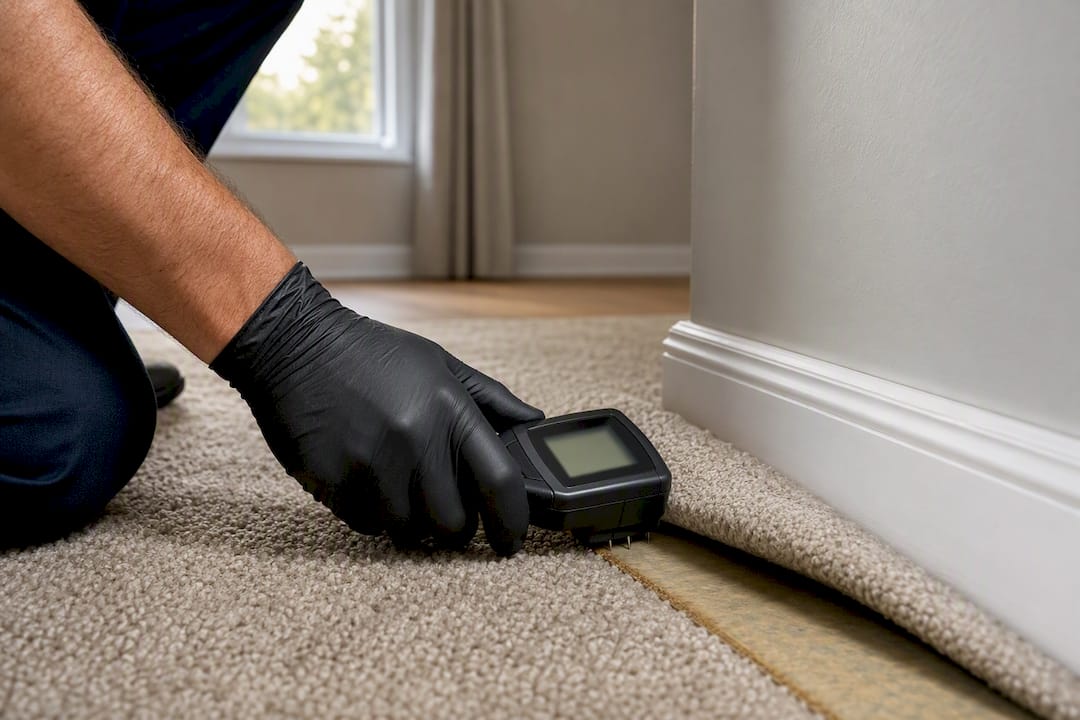
- Moisture meters and hygrometers are the only reliable way to check progress. Carpet can feel dry to the touch on top while the pad underneath is still saturated.
Pro Tip: Never shut equipment off overnight to save on the power bill. Turning air movers and dehumidifiers off for even eight or nine hours can add days to your total drying time and gives mold a head start it won’t give back.
Continuous, round-the-clock operation is consistently the single biggest factor in shortening the overall timeline, more than any single piece of equipment.
How Long Does It Take for Carpet to Dry After Water Damage?
With continuous professional equipment running nonstop, carpet typically dries in 2 to 5 days. Padding usually finishes faster, in the 48 to 72 hour range, though it’s often replaced rather than dried at all. Subfloor timelines vary widely depending on the material (concrete slab versus plywood) and how much water soaked through.
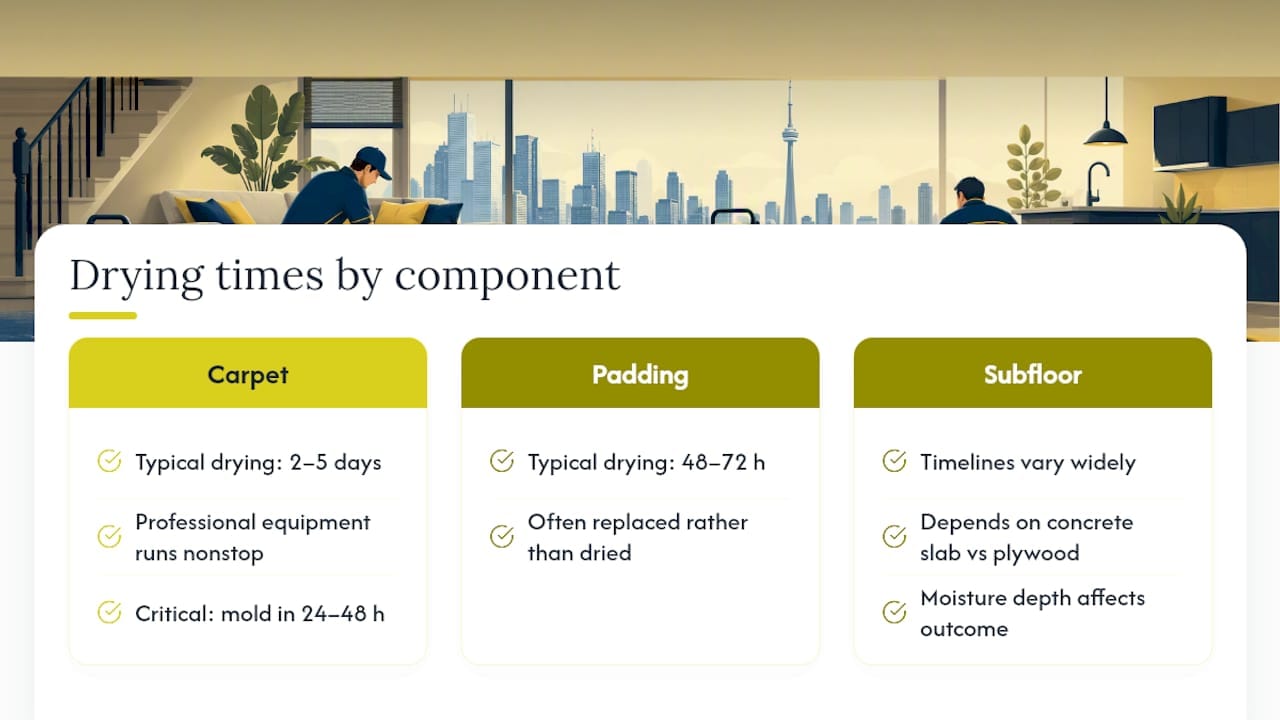
The clock that matters most isn’t the drying clock, though. It’s the mold clock. Mold can begin colonizing wet materials within 24 to 48 hours of the initial flooding, which is why extraction speed matters more than almost anything else you do. Every hour spent debating whether to call someone is an hour that window is closing.
Skip a night of dehumidifier operation and you’re not just adding time. You’re risking hidden moisture creeping into wall cavities where nobody’s checking. Don’t trust your hand on the carpet fibers to tell you drying is finished. A moisture meter reading that matches an unaffected part of the house is the real benchmark. Surface-dry carpet with a damp subfloor underneath is exactly how mold problems show up three weeks later.
Should You Throw Away Wet Carpets or Try to Save Them?
The water category decides more of this than the carpet’s condition does. Restoration professionals sort flood water into three tiers, and understanding which category you’re dealing with changes every decision that follows:
- Category 1 (clean water): A burst pipe or supply line. Usually salvageable if you act within the first day or two.
- Category 2 (gray water): Washing machine overflow, dishwasher discharge, water with some contamination. Salvageable, but it needs professional sanitization, not just drying.
- Category 3 (black water): Sewage backups, floodwater, or water sitting long enough that gray water has degraded into black water, which extension guidance says can happen after roughly 48 hours untreated. Replace the carpet and pad. Don’t attempt to save it.
Padding almost never survives, regardless of category, because it absorbs water like a sponge and rarely dries evenly. Watch for concrete replacement signals: visible mold growth, carpet backing that’s starting to separate or delaminate, a sewage smell that lingers after initial drying, or any area that stayed saturated for more than 48 hours. Photograph all of it before disposal. Insurance adjusters need that documentation to process a claim, and once the carpet’s in a dumpster, you’ve lost your evidence.
When Should You Call a Restoration Professional?
Some situations are beyond what a wet/dry vac and a few fans can fix. Call a professional restoration crew when you notice:
- The water source is sewage, a sump pump failure, or outdoor floodwater. Contamination risk alone justifies professional handling.
- The saturated area covers more than a room or two, or water has traveled under walls and into adjoining spaces.
- The subfloor feels soft, spongy, or gives underfoot when you walk on it, a sign structural material has absorbed water.
- A musty or sewage odor persists after your own drying attempts, which usually means moisture is still trapped somewhere you can’t see.
When technicians arrive, ask what extraction equipment they’re using, how they’ll verify dryness, what documentation they’ll provide for your insurer, and what the expected timeline looks like. Professional mitigation with proper documentation tends to move insurance claims faster and reduces the odds of a mold problem surfacing months later.
What Field Experience Teaches About Carpet Drying After Flood Damage
The two mistakes that show up again and again on restoration calls are almost identical: someone used a household vacuum instead of proper extraction equipment, and someone turned the drying equipment off overnight to quiet the house down. Both choices feel reasonable in the moment. Both routinely add days to the job and turn a two-day dry-out into a five-day one with a mold problem attached.
One tactic that consistently shortens disruption: pulling carpet back to replace saturated padding and treat the subfloor directly, rather than trying to dry everything in place. It looks more invasive on day one. It’s usually faster and more reliable by day three. Technicians commonly observe this pattern on many jobs involving standing water for more than a few hours, and it’s rarely the DIY instinct homeowners reach for first.
Get Professional Help for Flooded Carpet Restoration
If your flooding involved contaminated water, spread across multiple rooms, or has already passed the 24 to 48 hour mark without extraction, this is past the point where fans and a rented dehumidifier will fix it. A local restoration company provides 24/7 emergency response across the Toronto and GTA area, with extraction equipment, industrial air movers and dehumidifiers, and moisture-meter verification that confirms drying is actually complete, not just carpet that feels dry on top.
Structural concerns, sewage contamination, or water that’s been sitting for more than a day or two are all situations where calling in a crew beats improvising with hardware-store equipment. A professional restoration service can handle the full process: damage assessment, extraction, continuous drying, and repairs where needed, with documentation your insurer can actually use. If your carpet is still wet right now, get in touch with Speedycons’ water damage restoration team and get equipment on-site before the mold clock runs out.
Where to Verify These Drying Standards
For readers who want the source material: the IICRC S500 standard covers professional water-damage restoration procedures, while NC State Extension addresses carpet salvageability and contamination risk directly.
Sources
- Flooded Carpet Restoration: 24-Hour Action Plan | Clarketon Restoration
- Water-Damaged Carpets and Rugs | NC State Extension Publications
Recommended
- Water Damage Restoration GTA
- How Fast Mold Grows After Water Damage | 24-48 Hours?
- Mould Remediation GTA | Professional Mould Removal Service
Need professional help? Explore asbestos abatement services.