
If your home has a popcorn ceiling installed before about 1980, treat it as potentially containing asbestos and leave it alone until you know more. Don’t drill, sand, or scrape it. Get it tested or hire an accredited inspector first. If the material is intact and undisturbed, leaving it in place or sealing it is often the safer, cheaper route. Removal is for ceilings that are damaged, crumbling, or about to be torn into during a renovation.
TL;DR:
- Ceilings installed before 1980, especially between 1950 and 1986, are likely to contain asbestos, even if they look intact or clean.
- Testing with water-misted sampling by an accredited lab costs around $30 to $600, with results guiding whether to leave, seal, or remove the material.
- Leave asbestos-containing ceilings undisturbed if they are stable, but remove or encapsulate them if damaged, water-damaged, or during renovation.
- Water damage dramatically increases the risk of fiber release, requiring immediate containment, professional assessment, and possibly full removal.
- Hire a licensed asbestos abatement contractor if the ceiling is friable, damaged, or a renovation will disturb it, to ensure proper containment and disposal.
Table of Contents
- How Can You Tell If Your Popcorn Ceiling Has Asbestos?
- How Do You Test a Popcorn Ceiling for Asbestos?
- What Should You Do If the Test Comes Back Positive?
- When Should You Hire a Licensed Asbestos Abatement Contractor?
- What Should You Do Right After Water Damage or a Ceiling Collapse?
- How Speedy Construction & Restoration Handles Testing and Abatement
- The Real Mistake Homeowners Make With Old Ceilings
- Get Professional Help With Popcorn Ceiling Asbestos
- Sources
How Can You Tell If Your Popcorn Ceiling Has Asbestos?
The single biggest clue isn’t what the ceiling looks like. It’s when it went up. Textured “popcorn” or “cottage cheese” ceilings installed between 1950 and 1986 carry the highest probability of containing chrysotile asbestos, typically at concentrations of 1% to 10% by weight. Manufacturers phased out asbestos in spray-applied ceiling texture through the 1980s, and most products made after 1990 are asbestos-free. But “most” isn’t “all,” and contractors sometimes used up old stock for years after regulations tightened.
Here’s the problem with judging by eye: color, sheen, and clumping tell you nothing reliable about fiber content. A bright white, freshly painted ceiling from 1978 can be loaded with asbestos, while a yellowed, water-stained one from 1994 might be completely clean. Weak visual “tells” people rely on, like a coarser texture or a slightly grayish tint, aren’t diagnostic. Asbestos fibers are microscopic. You cannot see them, smell them, or feel them in the material.
To pin down installation date, check:
- Building permits or renovation records filed with your municipality
- Seller disclosure statements from your purchase agreement
- Property assessor or land registry records showing the build year
- Prior inspection reports if the home changed hands recently
If your home was built or last had ceiling texture applied before 1980, assume the ceiling is suspect until a lab says otherwise.
How Do You Test a Popcorn Ceiling for Asbestos?
Testing starts with keeping fibers from becoming airborne in the first place. The standard approach is a wet-sampling method: lightly mist the ceiling area with water, then mist the sampling tool itself, before removing a small chunk of material. That sample goes straight into a double-sealed bag for transport to a lab, which keeps loose fibers from drifting into the room while you work. Homeowners can technically do this themselves, but many choose to hire an accredited inspector instead, since sampling by hand still carries some risk of disturbance, and a professional report holds more weight with buyers, insurers, or contractors later.
Labs analyze samples using Polarized Light Microscopy (PLM), and occasionally Transmission Electron Microscopy (TEM) for more precise fiber counts when results are borderline. Results are reported as percent asbestos by weight. Look for labs with NVLAP accreditation or an equivalent recognized standard, since that’s what makes the report defensible if a dispute ever comes up.
Pro Tip: Sample more than one room. Texture applied in different phases of a home’s history can vary in composition, so a clean result in the hallway doesn’t guarantee the bedroom ceiling is safe too.
Cost and speed:
- Mail-in DIY test kits run about $30 to $50, plus lab fees.
- Professional sampling and inspection typically costs $250 to $600, including the report.
- Turnaround is usually 3 to 10 business days depending on the lab’s workload.
What Should You Do If the Test Comes Back Positive?
A positive result doesn’t automatically mean you need a demolition crew. The right move depends almost entirely on the ceiling’s condition and what you’re planning to do with the room.
Leave it alone if the material is intact, undisturbed, and you have no renovation plans. Asbestos-containing texture that’s stable poses little risk when left alone. Maintain it by painting over it gently with a roller (never sanding first) and avoiding drilling, hanging fixtures, or running cables through it.
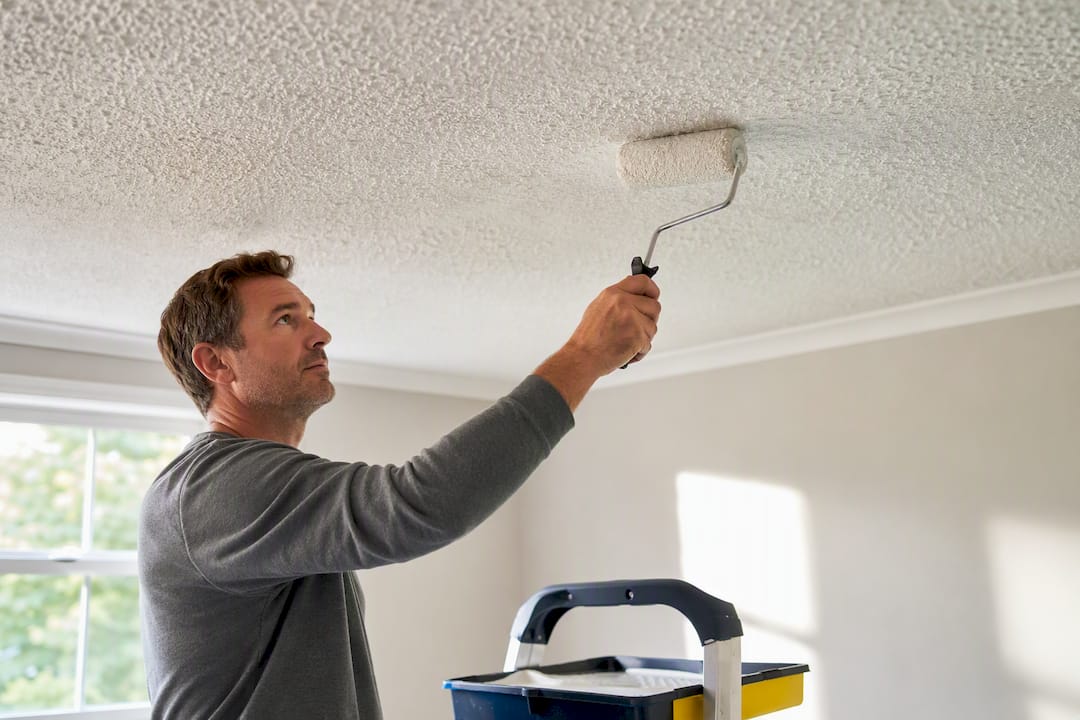
Encapsulate or cover it when you want a fresher look without full abatement. A specialized encapsulant seal, or a drywall layer installed directly over the existing texture, locks fibers in place. This is often the middle-ground choice: cheaper than removal, and it lets you renovate around the material instead of removing it outright. The tradeoff is that the ceiling remains asbestos-containing underneath, which matters for future disclosure and any work that penetrates the surface later.
Remove it when the material is friable (crumbling, flaking, water-damaged) or when a renovation will disturb it regardless. This is the point where licensed abatement becomes necessary rather than optional, and where disposal has to follow regulated hazardous-waste procedures rather than a regular construction dumpster.
| Management option | Best for | Typical cost driver |
|---|---|---|
| Leave in place | Intact ceiling, no renovation planned | Cost of testing only |
| Encapsulate or cover | Cosmetic update, ceiling still stable | Sealant or drywall labor |
| Professional removal | Friable, damaged, or renovation will disturb it | Abatement crew, containment, disposal fees |
When Should You Hire a Licensed Asbestos Abatement Contractor?
The moment your ceiling is friable, damaged, or you’re planning demolition, this stops being a homeowner project. Licensed crews set up sealed containment zones, use negative-pressure HEPA filtration to keep fibers from escaping into the rest of the house, wet the material before removal to suppress dust, and follow strict waste-handling protocols for disposal. DIY dry-scraping or vacuuming suspect material with a regular household vacuum is one of the fastest ways to contaminate an entire home, since ordinary vacuums aren’t built to trap fibers that small.
Before signing a contract, ask for:
- A current asbestos abatement license valid in your jurisdiction
- Proof of liability insurance
- References from recent, comparable jobs
- Waste disposal manifests showing where material ends up
- A written scope of work and project timeline, not a verbal estimate
Bids usually bundle two phases: abatement itself, then refinishing (patching, priming, repainting the bare ceiling). A straightforward single-room job might wrap in a few days; a whole-house project with major refinishing runs longer. Vetting containment procedures upfront saves you from surprises once demolition starts.
What Should You Do Right After Water Damage or a Ceiling Collapse?
Water and asbestos texture are a dangerous combination. A stable ceiling that’s been fine for decades can turn into a fiber-release event the moment it gets soaked, crumbles, or drops chunks onto the floor. Here’s the sequence that limits exposure:
- Get everyone out of the room and close the door to restrict access.
- Shut off the HVAC system immediately so fibers don’t circulate through ductwork into other rooms.
- Do not sweep, dry-vacuum, or touch debris. Leave it exactly where it fell.
- Contain the source of the leak if it’s safe to do so, without disturbing the damaged ceiling material further.
- Call for sampling and professional cleanup before anyone re-enters to assess the damage more closely.
Water damage also tends to spread contamination into fabrics, carpet, and HVAC systems nearby, which is why a soaked asbestos ceiling almost always graduates from a “manageable in place” situation to a “professional removal required” one.
How Speedy Construction & Restoration Handles Testing and Abatement
Speedycons combines water damage response with asbestos abatement under one roof, which matters because the two problems so often show up together. Trained technicians follow code-compliant procedures and are available for 24/7 emergency response when a ceiling starts crumbling at 11 p.m. on a Sunday.
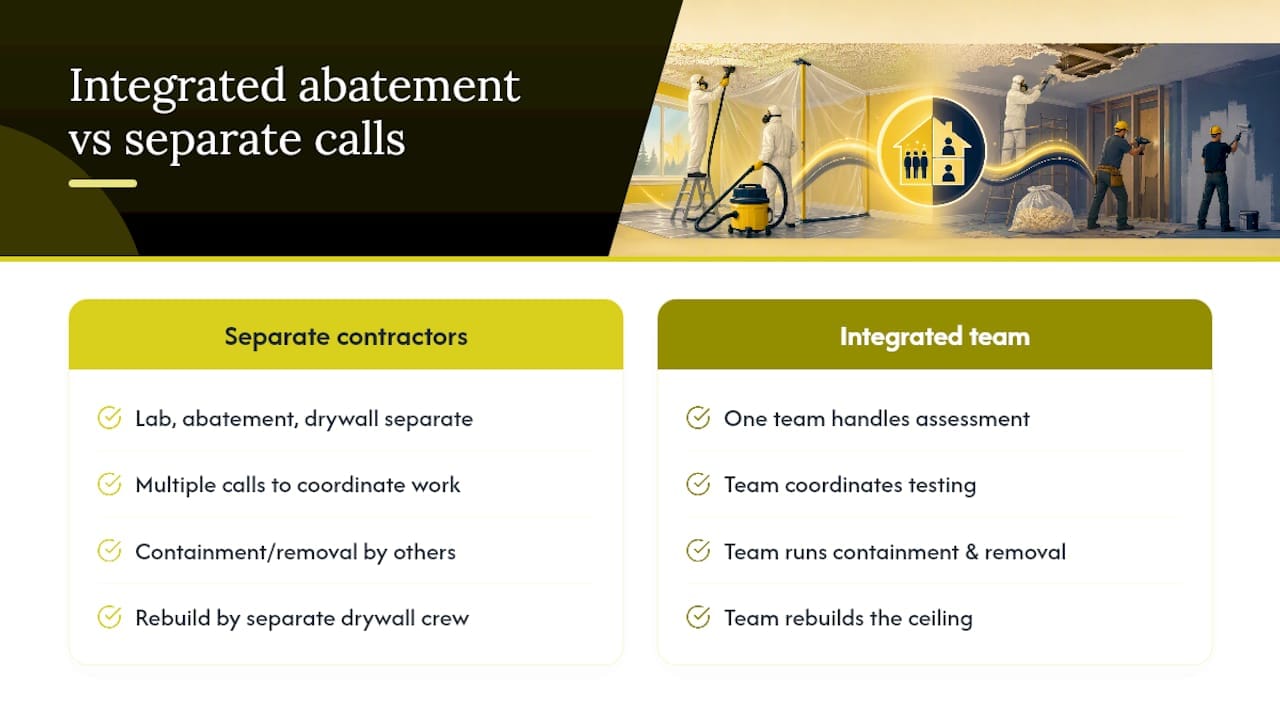
The process runs in a predictable sequence: an on-site assessment first, then controlled sampling or coordination with an accredited testing lab, followed by containment and abatement work, and finally disposal and reconstruction of the ceiling itself.
A single point of contact managing testing, abatement, and rebuild removes the coordination headache that usually falls on the homeowner. That’s the real value of hiring one firm instead of stitching together an inspector, an abatement crew, and a drywall contractor separately.
Call Speedycons when you’re facing emergency water damage near a textured ceiling, visible crumbling, or simply want one contractor managing the whole process from start to finish.
The Real Mistake Homeowners Make With Old Ceilings
The research behind this guide points to one consistent failure in how people think about old popcorn ceilings: treating “intact” as a synonym for “safe forever.” It isn’t. The 1% asbestos threshold regulators use is an administrative trigger for abatement rules, not a line that separates dangerous from harmless. A ceiling sitting at 0.8% asbestos isn’t magically risk-free just because it falls under a bureaucratic cutoff.
Conventional advice tends to swing to one extreme or the other, either “rip it all out immediately” or “don’t worry about it, it’s probably fine.” Both miss the point. The condition of the material matters more than the percentage on the lab report. A stable, painted, undisturbed ceiling from 1975 is a manageable long-term situation. That same ceiling after a roof leak is an emergency.
If you take one thing from this guide, prioritize testing before any drilling, sanding, or renovation touches the surface, and treat water damage on a suspect ceiling as an immediate trigger for professional evaluation rather than a wait-and-see repair.
Get Professional Help With Popcorn Ceiling Asbestos
Speedycons is the practical next step once testing confirms a problem or water damage has already compromised your ceiling. Instead of juggling separate calls to a lab, an abatement crew, and a drywall contractor, one team handles the assessment, coordinates the testing, runs the containment and removal, and rebuilds the ceiling afterward.

This matters most when a burst pipe or roof leak hits a home with an older textured ceiling, since fiber release risk and water damage restoration become the same emergency call rather than two separate headaches. Speedycons’s asbestos abatement services across Toronto and the GTA cover exactly that scenario, and the team’s water damage restoration crews respond around the clock when a leak has already started soaking a suspect ceiling.
If you’re staring at a stained or crumbling popcorn ceiling right now, request an on-site assessment before you touch it. That single step determines whether you’re looking at a simple encapsulation job or a full abatement, and it’s the fastest way to stop guessing and start fixing the actual problem.
This article is general information, not a substitute for advice from a qualified doctor. Consult a qualified healthcare professional about your own circumstances before acting on anything here.
Sources
- How to Test Popcorn Ceiling for Asbestos DIY - InspectandTest
- Peer-reviewed case study documenting health risks from spray-applied acoustic ceilings and the friable behavior of textured asbestos materials
- Asbestos ceiling & textured paint ID & removal - InspectApedia
Recommended
- Top Mistakes Homeowners Make During Asbestos Removal
- DIY Asbestos Removal Risks Every Homeowner Must Avoid
- Containment Procedures Used in Asbestos Removal Safety
Need professional help? Explore asbestos abatement services.