
Shut off the water immediately, then address electrical risk before you step into any standing water. Photograph the damage once it’s safe to do so, and start pulling out water within the hour, since mold can begin growing in 24 to 48 hours. If the leak is spreading past one small area or you can’t isolate it yourself, call a licensed plumber and a restoration contractor at the same time.
TL;DR:
- Shutting off the main water supply and electrical circuits immediately prevents further damage and reduces safety risks during a burst pipe incident.
- Document damage with timestamped photos before moving anything, and keep all receipts for repairs to streamline insurance claims.
- Rapidly drying affected areas with continuous fans and commercial dehumidifiers within 48 hours is essential to prevent mold growth.
- DIY pipe repairs using rubber sleeves or epoxy are temporary fixes, while professional plumbers are needed for hidden or extensive pipe damage.
- Prevention measures, such as insulating pipes and maintaining temperatures above 55°F, significantly lower the risk of burst pipes in cold weather.
Table of Contents
- Immediate actions after a burst pipe
- How do you document the damage for insurance?
- Removing standing water and salvaging what you can
- How long does it take for water damage to cause mold?
- Fixing the pipe: DIY limits and when to call a pro
- Preventing burst pipes before winter hits
- A quick note from Speedy Construction & Restoration
- When to call Speedy Construction for water damage restoration
- Sources
Immediate actions after a burst pipe
Find your main shutoff valve before you ever need it. It’s usually near the water meter, in the basement, a crawlspace, or along the foundation wall closest to the street. Turn it clockwise until it stops, then open a few faucets to drain the remaining pressure out of the lines. If the burst is limited to one fixture, like under a sink or behind a washing machine, the local shutoff valve at that fixture may be all you need.
Electricity and water together are the real danger here, not the mess. If water has reached outlets, baseboard heaters, or an electrical panel, shut off that circuit at the breaker box before you go near it, and never touch a breaker while standing in water. If you’re not sure a circuit is safe, leave the main breaker off entirely and wait for an electrician to clear it before restoring power to wet areas.
Before you start cleanup, gear up:
- Rubber boots and waterproof gloves
- Eye protection if you’re dealing with debris or ceiling material
- An N95 mask if the water looks contaminated or has been sitting for a while
- Keep kids and pets out of the affected area entirely
Frozen pipes are the most common cause of a burst in the first place. Water expands as it freezes and can build pressure strong enough to split copper or PVC. If you catch a pipe frozen before it bursts, never use a torch or space heater directly on it. Gentle heat, like a hair dryer on a low setting, works safely once you’ve relieved pressure at the nearest faucet first. Managing this kind of electrical risk after water damage is one of the most overlooked steps homeowners skip in the panic of the moment.
How do you document the damage for insurance?
Insurance adjusters move faster when you hand them a clear paper trail, not a vague description of “a lot of water everywhere.” Before you touch anything you don’t have to move:
- Take wide shots of every affected room, then close-ups of the pipe itself, serial numbers on appliances, and the meter location.
- Timestamp your photos (most phones do this automatically) and keep the originals until your claim is fully closed.
- Figure out where the break actually is. If it’s at or before the water meter, the utility is typically responsible; if it’s inside your walls or under your slab, that’s on you to fix.
- Save every receipt, including the wet/dry vac rental, the emergency plumber’s invoice, and any hardware store run for tarps or buckets.
Removing standing water and salvaging what you can
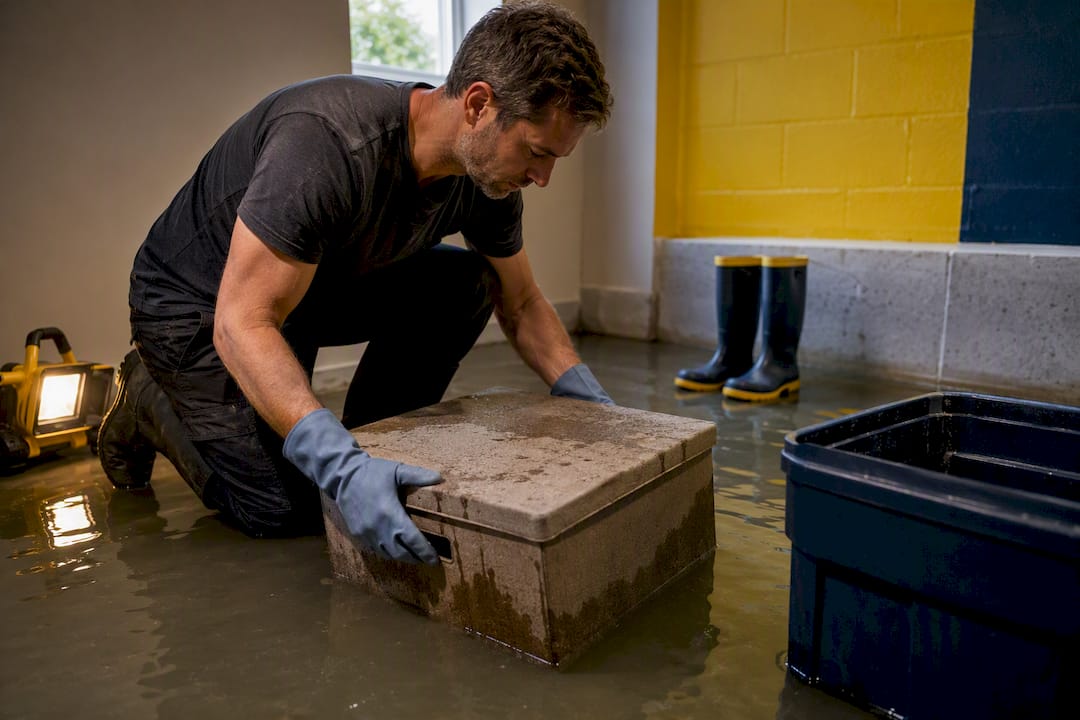
Match your tool to the depth of the water. A few inches on a hardwood floor comes up fine with towels and a mop. Once it’s ankle deep or covers a wider area, a wet/dry vac earns its cost, and anything approaching a flooded basement calls for a submersible pump, which most hardware stores rent by the day. Skip the regular household vacuum entirely. It’s not built for water and can shock you.
Contents matter as much as the floor underneath them:
- Pull back carpet and remove the padding underneath. It rarely dries fully and usually needs replacing.
- Elevate furniture legs on wood blocks or foil to stop wicking from a wet floor.
- Unplug electronics and appliances, photograph them in place first, then move them to a dry area to assess later.
Pro Tip: Don’t dump extracted water down an interior floor drain if you can avoid it. Most residential drains aren’t built for that volume and can back up elsewhere in the house. Send it outside or down an exterior grade instead.
If the water looks gray, brown, or has an odor, treat it as contaminated. That changes what’s salvageable, and it’s worth checking what items are realistically worth saving before you spend hours trying to rescue something a professional would tell you to toss.
How long does it take for water damage to cause mold?
Mold doesn’t wait for you to finish mopping. It can take hold within 24 to 48 hours of water sitting on drywall, subfloor, or insulation, so drying is not a next-week task. It starts the same day as extraction.
Your target is indoor relative humidity under 50%. A box fan pointed at the wet area helps, but a real dehumidifier does the heavier lifting, and for anything beyond one room, a rented commercial-grade unit will outpace a household model by a wide margin.
- Run fans continuously, not just when you’re home to hear them.
- Check a hygrometer daily until humidity holds steady below 50%.
- Use a moisture meter on walls and subfloor. Restoration crews look for consistent readings across a whole section of drywall or flooring, not just one dry-feeling spot.
One often-cited industry figure puts the average insurance claim for burst pipe damage in the low five figures, which tracks with how quickly a delayed dry-out turns a mop-up job into a demolition job.
“Dry to the touch” is a trap. Drywall can feel dry on the surface while the material behind it stays saturated for days, which is exactly the environment mold needs. If you spot any fuzzy growth, discoloration, or a musty smell that won’t clear, stop drying it yourself and call a remediation crew.
Fixing the pipe: DIY limits and when to call a pro
A rubber sleeve and hose clamp, or a two-part epoxy putty, can stop an active leak for a day or two. Treat these as a stopgap, not a fix. A temporary patch buys time; it doesn’t replace the damaged section of pipe or catch a weak spot in the run next to it.
Call a licensed plumber when:
- The break is behind a wall, under a slab, or you can’t find it at all
- More than one room or fixture is affected
- You’re unsure how to isolate pressure without shutting off water to the whole property
Call a restoration contractor when:
- Water has soaked into walls, ceilings, or subfloor, not just the surface
- You can’t get the space fully dry within about 48 hours on your own
- You need moisture mapping, thermal imaging, or documentation your insurer will actually accept
Restoration crews often find wet pockets behind walls or under flooring that a homeowner’s eye and a paper towel would never catch, which is exactly why the scope (and the bill) sometimes grows after a walkthrough.
Preventing burst pipes before winter hits
A little prevention costs a lot less than another cleanup. Insulate any pipe running through an unheated basement, garage, or crawlspace, and keep your thermostat no lower than 55°F during a cold snap, even if the house is empty. Opening cabinet doors under sinks lets warm household air reach pipes tucked against exterior walls.
- Disconnect and drain outdoor hose bibs before the first freeze
- Consider an automatic shutoff valve or a leak detector near washing machines and water heaters
- Have older plumbing inspected every couple of years, especially in homes built before PEX and modern fittings became standard
Sealing up drafts around doors and windows helps too, since cold air infiltration is often what pushes a marginal pipe over the freezing point in the first place.
A quick note from Speedy Construction & Restoration
We’ve built our process around the fact that the first hour decides whether a burst pipe stays a mop-and-fan job or turns into a full reconstruction. Our technicians run the same sequence every time: assess the source and scope, extract standing water, set up drying equipment, repair or coordinate the pipe fix, then manage the project through to close.
When to call Speedy Construction for water damage restoration
If you’ve got active flooding, water you suspect has reached behind walls or under flooring, or damage spread across more than one room, that’s past the point where a shop vac and a box fan will solve it. It’s also the point where insurance documentation starts to matter more than elbow grease.

Speedy Construction runs a 24/7 emergency response across Toronto and the GTA, which means a technician can be assessing your property the same day you call, not scheduling you in for next week. That assessment includes moisture mapping to find wet pockets you can’t see, commercial-grade extraction and drying equipment that outperforms anything you’d rent at a hardware store, and a project manager who handles the paperwork your insurer needs. For homeowners and property managers who’d rather have one team own the whole process, from first extraction through full reconstruction, that continuity is the difference between a two-week fix and a two-month one. Get in touch through our water damage restoration services page to book an assessment and get a technician on-site fast.
Sources
- What to Do When a Pipe Bursts | Family Handyman
- Burst Pipe Water Damage: What to Do in the First Hour - Rhino Restoration
- Prevent or thaw frozen pipes, City of Toronto
- Pipe responsibilities, City of Winnipeg
Recommended
More Guides
Need professional help? Explore asbestos abatement services.